


The fascinating career of a Blue Jays legend
- Jack Hibbert

- Nov 11, 2025
- 5 min read
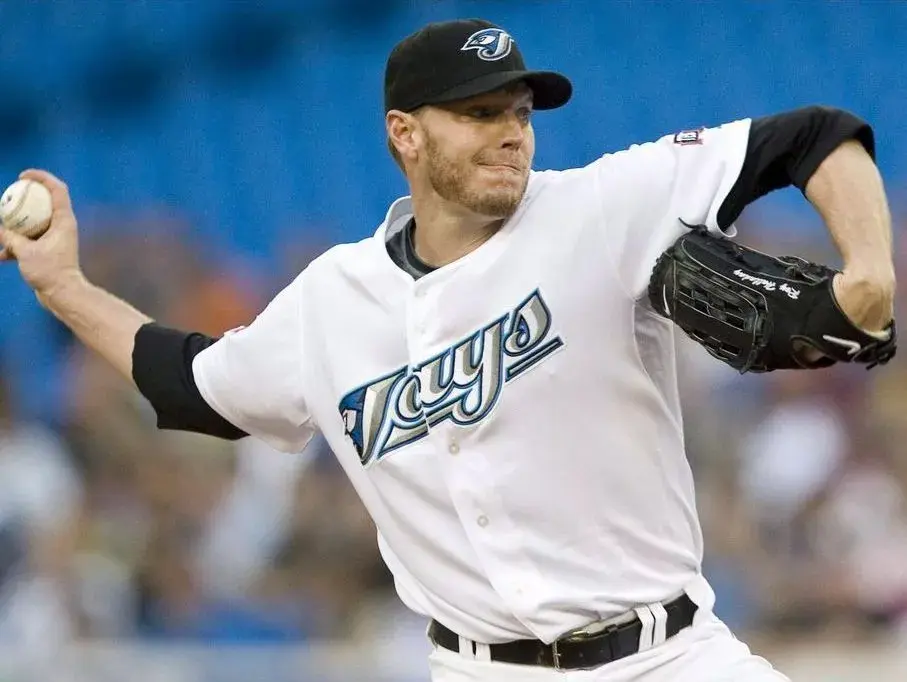
From his Major League debut in 1998 to his final season in Toronto in 2009, Roy Halladay was one of the few bright spots on a Blue Jays team whose performance was typically mediocre in a good year. Despite being widely viewed as one of the greatest Toronto Blue Jays players of all-time and one of the most dominant pitchers of the last few decades, Halladay's path to stardom was anything but usual.
First taste of professional baseball
The Blue Jays selected Halladay 17th overall in the 1995 draft out of Arvada West High School in Colorado. After ascending through the minor leagues, the Blue Jays promoted Halladay to the big leagues in 1998, where he made his MLB debut at Tropicana Field on September 20th against the expansion Tampa Bay Devil Rays. A week later, in his second major league start, Halladay lost a no-hitter with two outs in the 9th inning on a home run by Tigers' pinch hitter Bobby Higginson. The home run landed in the Blue Jays' bullpen, where it was caught by Dave Stieb. Stieb would retire after the 1998 season, with this being the Blue Jays' final game of the season, and therefore his career. Dave Stieb knows more about losing no-hitters after 26 outs more than anyone in human history, doing so three times (a story for another time). Building off a strong couple of starts to begin his major league career, Halladay's rookie season in 1999 was very successful. He would go 8-7 with a 3.92 ERA and record 2.6 wins above replacement, with exactly half of his 36 appearances on the season coming in relief. The future looked promising for the right-hander who was a first round draft choice just four years prior. However, Halladay's career was about to take a turn which nobody could have predicted.
Minor league retooling and return to the bigs
In 2000, Halladay would have a nightmareish season. His ERA nearly tripled to a mark of 10.64, including 8 of his 13 starts in which he allowed 6+ earned runs. Halladay's ERA would be the highest in baseball history for a pitcher with a minimum of 50 IP in a single season. The following spring, Halladay was sent down to the minors... all the way to single-A Dunedin to completely rework his mechanics with former Toronto pitching coach Mel Queen and former manager, then-club advisor, Bobby Mattick. Queen himself had made a significant move after being demoted to the minor leagues, converting from an outfielder to a pitcher with the Cincinnati Reds' minor league affiliate — the San Diego Padres. In the minors, Queen was harsh on Halladay, himself stating that Halladay was "very unintelligent about baseball" despite clearly having the potential to be a star. Queen worked with Halladay to completely overhaul his delivery, along with sports psychologist Harvey Dorfman, who coached Halladay through them mental side of pitching and helped view Queen's strict approach from a different perspective. Halladay's wife Brandy gifted Roy a copy of Dorfman's book, The Mental ABC's of Pitching, which he continued to carry for the rest of his pitching career. Throughout the first half of the 2001 season, Halladay would work his way back up through the Jays' farm system, returning to the bigs on July 2nd. He struggled mightily in his return, allowing six earned runs in 2.1 innings to a Red Sox team who would finish the season just slightly over .500 at 82-79. Despite the awful performance, the Blue Jays decided to stick with Halladay, in a decision that would work out greatly in their favour. Halladay pitched incredibly well for the rest of the season, and, when eliminating that outlier of a first start, would finish the year pitching 103 innings with a 2.71 ERA.

These two slow-motion videos illustrate the differences in Halladay's pitching mechanics before his minor league retooling with Mel Queen and afterwards. Prior to his work with Queen, Halladay was much too reliant on velocity, something that should come second, behind control, when pitching. Queen worked with Halladay to lower his arm slot, allowing for more control and movement on his pitches.
Becoming a star and leaving Toronto
After his complete overhaul in the minor leagues, Roy Halladay soon reached his full potential as a pitcher. In 2002, only a year after being demoted to single-A, Halladay would make his first All-Star team and finish the season with 7.3 WAR, leading the American League. The following season, Halladay would have one of the best pitching seasons in Toronto Blue Jays history. Halladay won his first career Cy Young Award, marking the Jays' fourth winner in 8 seasons. Despite having a solidified ace in their rotation, the Blue Jays consistently struggled, finishing above third place in the AL East only once (2006) during Halladay's time as a Blue Jay.
Although Halladay had tremendous individual success, he expressed a desire to pitch for a competitive team and reach the postseason for the first time in his career. After 12 seasons in Toronto consisting of six All-Star nods and five top-5 finishes in American League Cy Young voting, he was traded to the Philadelphia Phillies on December 15th, 2009. In return, the Blue Jays would receive prospects Travis d'Arnaud, Kyle Drabek, and Michael Taylor. Drabek was the only one of the three players acquired to reach the majors in Toronto, and recorded a -0.1 WAR in 39 games pitched over five seasons with the Blue Jays. d'Arnaud has carved out a solid MLB career and is still playing for the Los Angeles Angels, although he was traded to the New York Mets as a part of the deal to acquire reigning NL Cy Young Award winner R.A. Dickey prior to the 2013 season and never played for the Blue Jays.
Halladay only boosted his Hall of Fame candidacy in Philadelphia. In 2010 — Halladay first season with the Phillies — he would win his second career Cy Young Award, becoming just the 5th pitcher to win the award in both leagues. On May 29th of that season, Halladay pitched the 20th perfect game in MLB history against the Florida Marlins, a feat which no Blue Jays has ever accomplished. Halladay followed up the historic feat with an even rarer one — a postseason no-hitter. In his postseason debut, Halladay no-hit the Cincinnati Reds in game 1 of the NLDS, joining Don Larsen's perfect game as the only two no-hitters in postseason history. The following season, in 2011, Halladay would make his 8th and final All-Star team, and finish runner-up in Cy Young voting to the Dodgers' Clayton Kershaw.
Legacy
On November 7th, 2017, Halladay, who had followed in his father's footsteps and taken up flying during his retirement, died after crashing his plane into the Gulf of Mexico. In a ceremony prior to the Jays' home opener the next season, Halladay's #32 was retired by the club, making him the only in franchise history to recieve the honor. In 2019, Halladay was posthumously inducted into the Baseball Hall of Fame, receiving over 85% of the vote on his first ballot and becoming the second player to reach Cooperstown primarily as a Blue Jay (after Roberto Alomar. Unfortunately, despite most of his career and achievements coming in Toronto and Halladay himself stating that he would choose to be inducted into the Hall of Fame as a Blue Jay, his plaque features no logo.

In an era where most starting pitchers are content to go only 6 innings, Halladay was the last of a dying breed. He planned on finishing every game that he started, an approach that little-to-no current pitchers, managers, or front office members consider. Roy Halladay is missed tremendously both on and off the field, and is undoubtedly one of the top faces of the Toronto Blue Jays franchise.
Comments