

Franchise History
Despite many ups and downs, the Blue Jays have been one of the most successful expansion franchises since their inception in 1977.
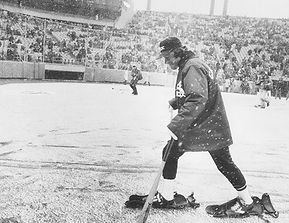
From the franchise's first game in history on a snow-covered Exhibition Stadium field to Joe Carter's walk-off home run to clinch a second consecutive World Series title, many of baseball's most iconic moments have come at the hands of the Toronto Blue Jays

Prior baseball in Toronto
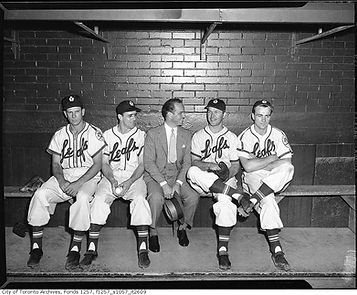
Before the arrival of the Blue Jays in 1977, Toronto was home to the Maple Leafs. Pre-dating the NHL team of the same name, the Maple Leafs played in the International League — Minor League Baseball's highest level — from 1896 to 1967, (which coincidentally, is the last year the hockey Maple Leafs appeared in the Stanley Cup!).
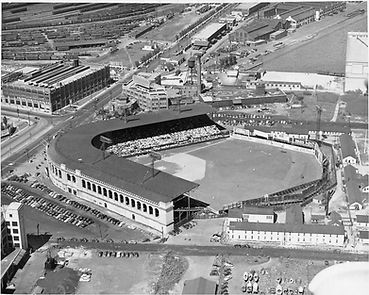
In possibly the most historically significant baseball event in Toronto history, while playing against the Maple Leafs in 1912, a player for the Providence Grays named George Ruth hit his first professional home run. That took place at Hanlan's Point Stadium on Toronto Island, where the Maple Leafs would play until moving into the new Maple Leaf Stadium in 1926.
After facing financial difficulties, the Maple Leafs would relocate to Louisville, Kentucky following the 1967 season and the city would be without a professional baseball team for a decade.
Many notable figures played and managed for the Maple Leafs during their storied existence, including Sparky Anderson, whose job as skipper of the Maple Leafs was the first of his Hall of Fame managerial career. Catcher Phil Roof, who played for the Maple Leafs in 1963, would go onto finish his career with the Blue Jays during their 1977 expansion season, being the only player to suit up for both of Toronto's profesional baseball clubs.

Major League expansion
When the American League decided to add two expansion teams for the 1977 season, there were a handful of cities in the running for a new franchise. Toronto, along with Seattle, were the two cities awarded an expansion club, and the Blue Jays were born.
After an ill-fated bid to buy the San Francisco Giants and relocate the team to Toronto, a group consisting of Labatt Breweries, Webster, and CIBC paid a $7 million expansion fee to establish a franchise.
The team was to play in Exhibition Stadium, which had been retrofitted for baseball in anticipation of the Giants' arrival in the city. The name "Blue Jays" was chosen in a name-the-team contest, following in the footsteps of previous Toronto sports teams wearing the color blue and MLB's two other bird teams: the Baltimore Orioles and St. Louis Cardinals.
On April 7th, 1977, the Blue Jays faced the Chicago White Sox in their inaugural game. Despite the freezing temperatures and snowy conditions, the Blue Jays defeated the White Sox 9-5, with first baseman Doug Ault hitting the first two home runs in franchise history.


Early success
In 1985, the Toronto Blue Jays won the American League East, reaching the postseason for the first time. The club was led by starting pitcher Dave Stieb, who remains the franchise's all-time leader in WAR and many pitching categories. After gaining a 3-1 series lead, the Blue Jays would ultimately be defeated by the Kansas City Royals. In 1987, despite not reaching the postseason with a 96-66 record — second-best in the major leagues — left fielder George Bell became the first Blue Jay to win AL MVP.
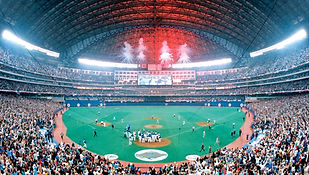
During the 1989 season, the Blue Jays would move into their new, retractable roofed home — SkyDome. On June 5th of that year, the Blue Jays played their first game at the SkyDome, losing 5-3 to the Milwaukee Brewers with first baseman Fred McGriff hitting the first home run in the ballpark's history. Two years later, in 1991, SkyDome would host the MLB All-Star Game for the first time.
On September 2nd, 1990, after losing three prior no-hitters with two outs in the 9th inning, including back-to-back starts in September of 1989 and a perfect game bid against the Yankees in 1990, Dave Stieb finally pitched his long-awaited no-hitter against the Cleveland Indians. As of 2025, this remains the only no-hitter in Blue Jays history.


Back-to-back World Series titles
After defeating the Oakland Athletics in the 1992 ALCS, the World Series would finally live up to its name, being played in Canada for the first time ever. In the deciding game 6, the Blue Jays would take the lead in the top of the 11th inning on a two-run double by Dave Winfield. With two outs in the bottom of the 11th, Mike Timlin would take the mound with the tying run only 90 feet away. Otis Nixon bunted back to Timlin, who threw to Joe Carter at first base to clinch the Blue Jays' first World Series title. Catcher Pat Borders was awarded World Series MVP after his 9-for-20 performance in the series, with his career 3.6 WAR being the lowest total amongst award winners.
The following season, the Blue Jays would once again win the American League pennant and move on to face the Philadelphia Phillies in the Fall Classic. In game 6, Joe Carter hit a three-run, walk-off home run against Phillies reliever Mitch Williams to win the series, with Toronto becoming the first team to repeat as World Series champions since the Yankees in 1977-78. Future Hall of Famer Paul Molitor, acquired by the team in the previous offseason, would win World Series MVP after going 12-for-24 in the series to tie an all-time record. With the 1994 strike ending the season and the Blue Jays' already slim hopes of a three-peat, this would mark the beginning of a long postseason drought in Toronto.


Post-championship struggles
Despite encapsulating a 22-year postseason drought, the years following the Blue Jays' back-to-back World Series titles had a handful of bright spots. Top pitching prospect Roy Halladay would make his debut in 1998, and following some early career struggles, would go on to have a Hall of Fame career in Toronto. His #32 was retired in 2018 following his death and is the only uniform number currently retired by the club. Another star in the dark days of the team was catcher-turned-first baseman Carlos Delgado, whose 336 career home runs as a Blue Jay mark a franchise record. On September 23rd, 2003 against the Tampa Bay Devil Rays, Delgado became the 15th player in baseball history to hit four home runs in a single game.
In 2004, Rogers took over full ownership of the club, renaming SkyDome to Rogers Centre. After that season, the Montreal Expos would relocate to Washington, DC, leaving the Blue Jays as MLB's lone Canadian franchise. During this period, a relatively unknown player named Jose Bautista would become a superstar with the Blue Jays. In 2010, he cranked a franchise record 54 home runs and finished 4th in AL MVP voting. Prior to the 2015 season, one of the team's many failed prospects, Brett Lawrie, was traded to the Oakland Athletics in exchange for All-Star third baseman Josh Donaldson.


Return to relevance
The Blue Jays won the AL East in 2015, reaching the postseason for the first time in 22 seasons. After falling 2-0 in the ALDS against the Texas Rangers, the Blue Jays would rally back, winning the series in five games thanks to Jose Bautista's iconic bat-flip home run. In the ALCS, the Blue Jays would fall to the eventual World Series champion Kansas City Royals, ending the most successful season in over two decades.
Claiming a wild card berth in 2016, the Blue Jays defeated the Baltimore Orioles in the Wild Card Game, took down the Rangers in the ALDS for the second consecutive season, and fell to the Cleveland Indians in the ALCS. With many aging stars, the Blue Jays would enter another rebuild, though not nearly as long as their last.
In 2019, super-prospects Vladimir Guerrero Jr. and Bo Bichette would make their big league debuts, ushering in a new era of Blue Jays baseball and giving the club a young core to build a competive roster around. Having to play the 2020 season in Buffalo due to the COVID-19 pandemic, the Blue Jays would return to the (expanded) postseason, losing to the Rays in the Wild Card Series. The first half of the 2021 season would be split between Dunedin and Buffalo, before returning home to Toronto following a nearly two year absence in July of that year. After securing wild card berths in 2022 and 2023, falling to the Seattle Mariners and Minnesota Twins respectively, the Blue Jays would extend their postseason winless drought to 7 seasons.


Back to the World Series
After much speculation leading up to his free agent season, the Blue Jays signed superstar Vladimir Guerrero Jr. to a 14-year, $500 million contract shortly after Opening Day.
Following a disappointing 2024 campaign, the Blue Jays went from worst-to-first, winning the AL East for the first time in a decade. Toronto would take down the New York Yankees in 4 games in the ALDS before facing the Seattle Mariners in the ALCS. After falling down 2-0 in the series at home, the Blue Jays would come back to win in 7 games, with George Springer hitting a go-ahead, three-run homer in game 7. For the third time in franchise history and the first in 32 years, the Toronto Blue Jays were headed to the World Series.
The Blue Jays faced the defending champion Los Angeles Dodgers in the Fall Classic, being expected to fall quickly as a significant underdog. After returning to Toronto up 3-2 in the series, the team blew a 9th inning lead in game 7 and ultimately fell in 11 innings, making the Dodgers the first team to repeat as champions since the Yankees from 1998-2000.


